
Avoyelles Parish District Court
Louisiana district courts are the primary trial courts of general jurisdiction. Avoyelles Parish is served by the 12th Judicial District Court, a single-parish judicial district that sits in Marksville. The Louisiana Judiciary identifies the 12th Judicial District as a district court with two judges and one parish. The state court structure map for this project therefore resolves the primary trial court name to District Court and the trial-court file to district-court.html.
The district court is the local venue for many civil suits, criminal prosecutions, family and divorce cases, probate and succession matters, juvenile jurisdiction, and district-court traffic or criminal matters. The Clerk of Court is the record custodian for district-court filings, certified copies, record books, and many public instruments. Sheriff records, such as jail roster entries, incident reports, crash reports, and civil process service, are separate from the district-court case file even when they relate to the same event.
The official source image from the Clerk jury duty page references the 12th Judicial District Court and the courthouse jury location.
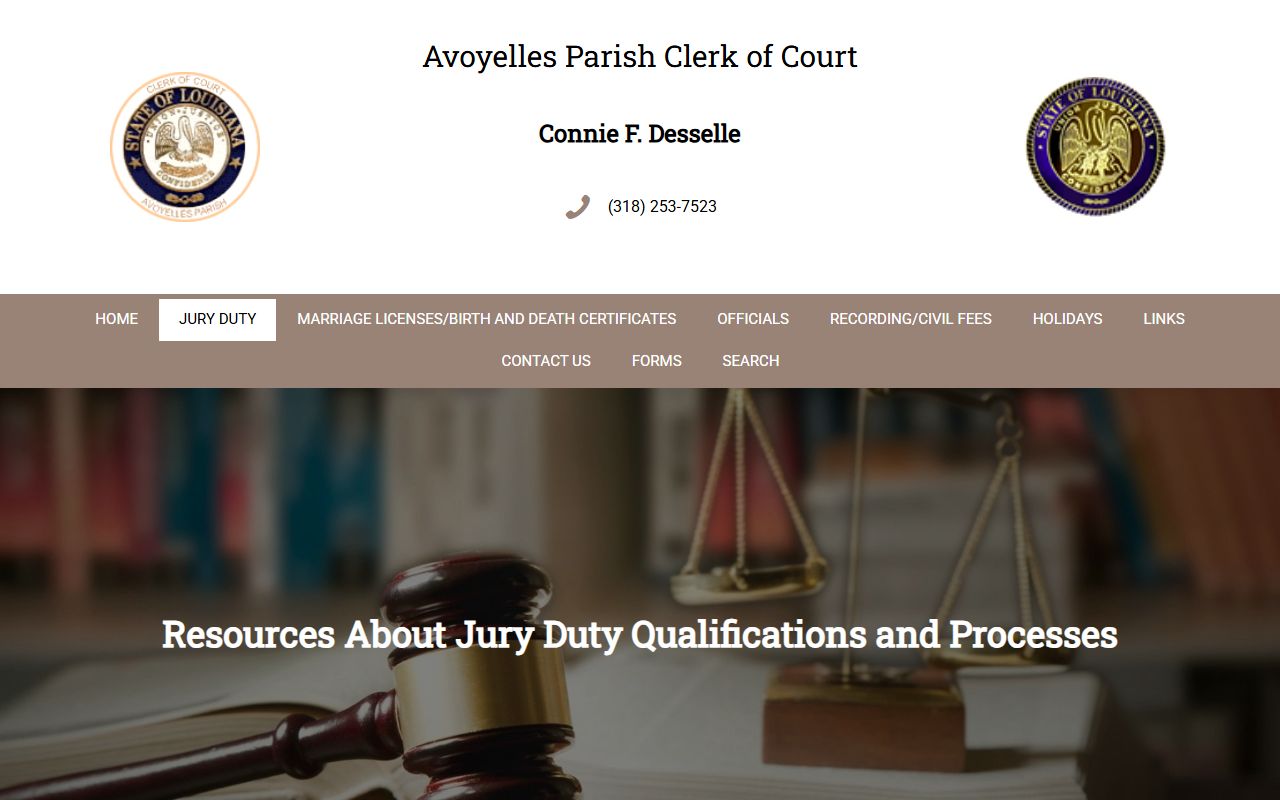
Jury service is one example of the Clerk, judges, and court staff working together inside the district-court system.
Avoyelles District Court Divisions
The 12th Judicial District Court sits in two divisions, Division A and Division B. The research did not locate a current official judge-specific public page for each Avoyelles division, so the division table stays with verified structural facts. A 2026-updated divisions appendix says each judge presides in the division to which the judge has been elected or appointed, and each division exercises the authority granted by law to district courts as to civil, criminal, probate, and juvenile jurisdiction.
| Court or division | Role | Address / contact | Verified notes |
|---|---|---|---|
| 12th Judicial District Court, Avoyelles Parish | General-jurisdiction trial court | Courthouse in Marksville; administrator P.O. Box 976, Marksville, LA 71351; (318) 253-8784 | Civil, criminal, family, juvenile, probate, and related district-court matters. |
| 12th JDC Division A | District-court division | Same courthouse and clerk structure | Current judge-specific public page not located in extracted sources. |
| 12th JDC Division B | District-court division | Same courthouse and clerk structure | Current judge-specific public page not located in extracted sources. |
| Avoyelles Parish Clerk of Court | Filing and records office | 312 North Main Street, Marksville, LA 71351; (318) 253-7523 | Maintains filings, record books, copies, marriage records, public instruments, and election duties. |
Note: Louisiana uses parishes and district courts, so "county court" is not the local court name for Avoyelles Parish.
District Court Jurisdiction Comparison
Avoyelles Parish has a general-jurisdiction district court, but not every local matter starts there. Louisiana also has lower limited-jurisdiction courts, including city courts, mayor's courts, and justice of the peace courts. Some traffic, ordinance, misdemeanor, small civil, and warrant-related matters may originate outside district court. The issuing citation, summons, warrant, or court notice is the best clue for which court holds the record.
| Point | District Court | City / Mayor's Court | Justice of the Peace Court |
|---|---|---|---|
| Main role | General trial court for Avoyelles Parish. | Limited local court for municipal, ordinance, misdemeanor, traffic, or city matters when available. | Limited local court for smaller civil or local matters depending on jurisdiction. |
| Record custodian | Avoyelles Parish Clerk of Court for district-court files. | Issuing local court, not necessarily the district-court Clerk index. | Issuing JP court or related local office. |
| Case types | Civil, criminal, divorce, family, probate, juvenile, and district traffic/criminal matters. | Traffic, ordinance, local misdemeanor, or municipal matters where that court has authority. | Small civil, local disputes, or limited matters where authorized. |
| Search clue | District-court docket number, division, Clerk record, or 12th JDC notice. | Citation, city court notice, mayor's court notice, or municipal filing. | JP notice, ward information, party names, or local summons. |
District Court Case Flow
District-court records are easier to read when the file is viewed as a sequence of events. A civil case usually begins with a petition, then service, answer or default activity, motions, hearings, judgment, and possible appeal. A criminal case may start with an arrest or investigation, but the court file tracks the charge filed or prosecuted in court, arraignment, pleas, motions, hearings, trial or plea, disposition, sentence, and possible appeal.
Civil flow: Petition filed › service › answer or default › motions or rules › hearing or trial › judgment › appeal.
Criminal flow: Arrest or summons › charge filed by bill or indictment › arraignment › pretrial motions › plea or trial › disposition › sentencing › appeal.
Probate flow: Succession petition › division allotment › will or intestate review › asset and heir review › judgment or order › certified copy and recording work.
The local rules add one specific timing detail: open-court filings, preliminary defaults, confirmation of defaults, and other uncontested matters may be taken up in either division regardless of allotment. They ordinarily are taken up at 9:00 a.m. on Mondays, but may be heard any time court is in session.
District Court Record Types
Civil district-court records may include petitions, answers, service returns, motions, rules, preliminary defaults, confirmations of default, judgments, garnishments, liens, and appeals. Criminal district-court files may include bills of information, indictments, docket entries, arraignments, pleas, motions, minute entries, trial settings, verdicts, sentencing, probation, restitution, and final disposition. Divorce and family records may include petition, answer, custody and support pleadings, community property documents, protective-order material, motions, hearing minutes, and the judgment of divorce.
Probate or succession records may include petitions, wills, affidavits, inventories, judgments of possession, letters, accountings, and notices. Juvenile and interdiction records may exist in the district-court structure, but they are more likely to contain restricted or redacted material. Online access should not be assumed to show every document in the file.
Search District Court Records
The central Avoyelles court-record search path is a multi-channel chain. COTT eSearch is the Clerk-branded account system. eVaultLA and the eClerks Statewide Portal help locate or open certain statewide clerk records, including civil, family, probate, marriage, and land records. Clerk Connect may include civil suits, criminal cases, property records, land records, and e-recording depending on participation and subscription. LCRAA is useful for land and marriage records, not a general criminal-court docket system.
- Identify whether the record is district-court, lower-court, sheriff, state, or federal.
- Use the Clerk's online systems when the record type fits the portal and account access is acceptable.
- Use the Clerk counter for certified copies, older files, restricted records, sealed-record questions, or non-digitized files.
- Use the Sheriff's Office for jail, booking, incident, offense, crash, civil process, sex offender, or custody records.
- Use federal PACER or CM/ECF only for federal cases.
Lower Courts and Warrants
City courts, mayor's courts, and justice of the peace courts can matter when the record is a local traffic citation, ordinance case, small civil matter, misdemeanor, or bench warrant tied to a local court appearance. The research did not locate a complete official Avoyelles lower-court directory with addresses and phones. That means the best search path is to use the issuing citation, court notice, warrant notice, or agency paperwork to identify the court before assuming the 12th JDC has the record.
For criminal charges, the District Attorney decides which charges are filed or prosecuted after an arrest. The official DA site and prosecutor directory identify Charles Riddle as District Attorney for Avoyelles Parish, 12th JDC. The public defender page lists District Defender Chad Guillot for District 12. These offices connect to criminal cases, but the Clerk remains the court-record custodian for filed district-court documents.
Avoyelles Court History
Avoyelles Parish's court system is rooted in Louisiana's parish-based civil-law system. The local district court today is the Twelfth Judicial District Court, a single-parish district covering Avoyelles Parish and sitting in Marksville. The local rules table states that 12th JDC rules apply to the Twelfth Judicial District Court, Parish of Avoyelles, and took effect February 1, 1999, under Louisiana civil, criminal, and children's code authority.
The Clerk's history is tied to both courts and public records. The office receives instruments for the public records and civil suits, assigns them to appropriate books, and serves as Chief Election Officer and Parish Custodian of Voting Machines. The research also notes a local legal-history detail: Louisiana Supreme Court Associate Justice Jeannette Theriot Knoll served from 1972 to 1982 as first assistant district attorney for the Twelfth Judicial District Court, Avoyelles Parish, and at one time served as a criminal defense attorney for indigents in Avoyelles Parish.
Federal Court Boundary
Federal records are outside the Avoyelles District Court system. Federal civil rights suits, federal criminal prosecutions, diversity cases, bankruptcy matters, federal habeas petitions, and federal appeals are searched through federal systems such as PACER and CM/ECF. The Western District of Louisiana is the relevant federal district context for Avoyelles Parish, but federal case files are not maintained by the Avoyelles Parish Clerk of Court.
The official source image from 28 U.S.C. 98 shows the federal statute placing Avoyelles Parish in the Western District of Louisiana.
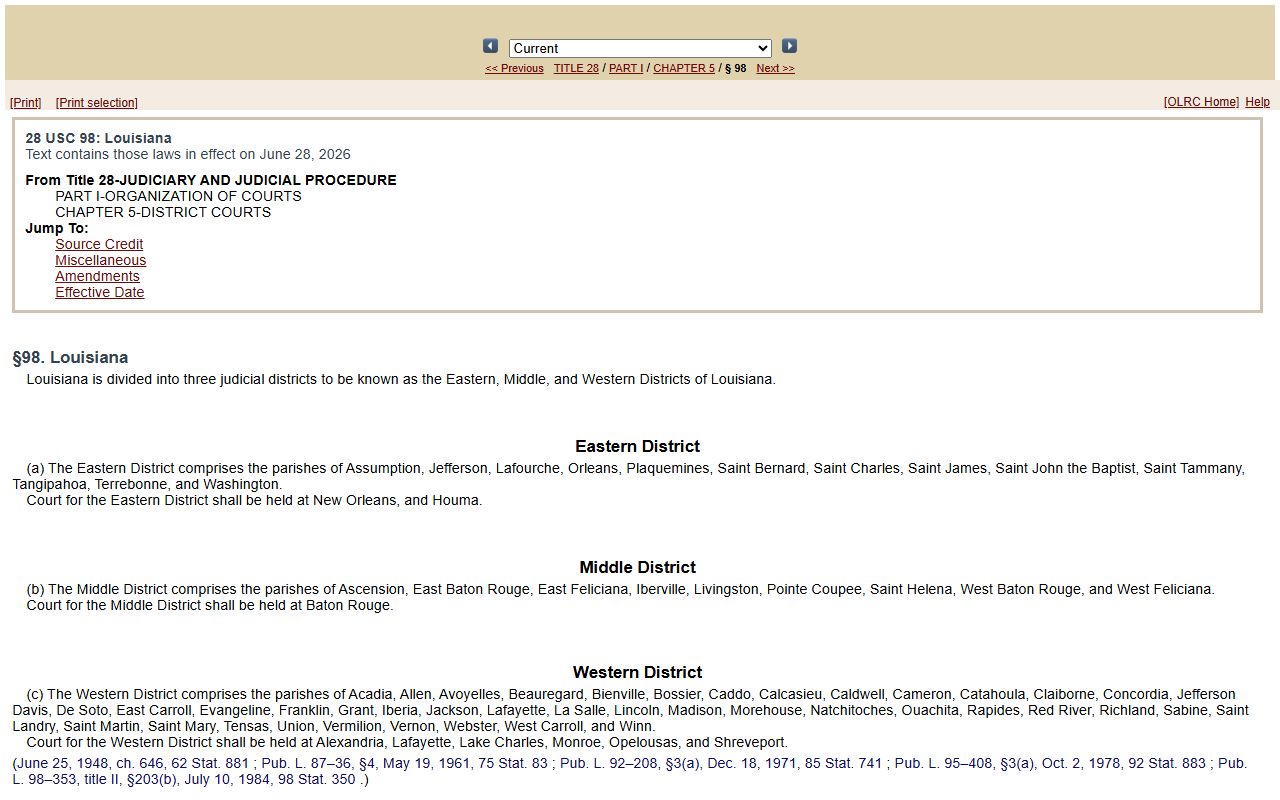
That federal boundary helps route federal searches correctly while keeping local district-court records with the parish Clerk.